 |
Dedication: Saints Helen and Daniel Location: Rushton Spencer Coordinates: 53.156953N, -2.090065W Grid reference: SJ940622 Heritage designation: none |
HOME - ENGLAND - STAFFORDSHIRE
|
Dedication: Saints Helen and Daniel Location: Rushton Spencer Coordinates: 53.156953N, -2.090065W Grid reference: SJ940622 Heritage designation: none |
It is seemingly difficult to identify any clear link between the cults of St Helen, St Daniel and the parish of Rushton Spencer: the local church is dedicated to St Lawrence, and the only British saint to whom the name "Daniel" could be attributed is the Welsh St Deiniol, who certainly had nothing to do with the area. Of course, the dedication of holy wells to St Helen does not appear to have been particularly uncommon during the medieval period, although it was very clearly much more common in the north of England, so perhaps her cult was simply very popular here. Regarding the well's purported second dedication to St Daniel, however, things are slightly more complicated, not least because there are a number of saints with that name.
Nevertheless, I have absolutely no doubt that the particular St Daniel associated with this well was the biblical figure of the Old Testament, who, because of his strong connections to prophecy, is often called "St Daniel the Prophet". It seems plausible that, perhaps in the late medieval period or at some stage afterwards, St Helen's Well became additionally dedicated to St Daniel the Prophet, as a result of the local legends that are linked to the spring. This would account for the otherwise highly unusual double patronage of the spring, although it is interesting to note that I have never seen the site called "St Helen and St Daniel's": it always appears to either be addressed by the name of one saint, or the other, but never together. This may indicate that the probably original dedication of the well to St Helen was partially overidden by that of St Daniel at a later stage.
Of course, the earliest reference that I have found to the spring, dating from 1686, when it was mentioned by Robert Plot in his History of Staffordshire, calls the site "St. Hellen's well" [sic], and makes no mention of its associations with St Daniel. Despite this, Plot did provide a description of the local tradition that was still attached to the well when he was writing:
|
ſometimes it comes to paſs that this well will grow dry, after a conſtant profluence perhaps of eight or ten years, and this not by degrees, but altogether of a ſudden; as well in wet, as dry years; and always about the beginning of May when the ſprings are commonly eſteemed higheſt, and ſo uſually continues, as I was credibly informed by the Worſhipful the ingenious Robert Wilmot of Eardley Eſq; till about Martin maſs following: And this the vulgar too imagin [sic], never happens but before ſome ſtupendous Calamity, or dearth, Warrs [sic], or other grand Revolution: thus they will tell you it grew dry before the laſt Civil-warr [sic]; again before the Martyrdom of K. Charles the firſt of ever bleſſed memory; again about 10 years ſince before a great dearth of Corne; and laſtly in An. 79. upon our late diſturbances. |
It is particularly interesting that all four examples given by Plot of the well's supposed future predictions took place in the 17th century: the "laſt Civil-warr" having taken place during the 1640s, the execution of Charles I in 1649, the "great dearth of Corne in around 1678, and the "late diſturbances" (a reference to the "Popish Plot") in 1679. This clearly shows that the belief that St Helen's (or St Daniel's) Well could predict future events was very strong throughout the 17th century. Indeed, there can be no certainty that this tradition is actually medieval, and did not itself evolve during the 17th century; of course, the fact that the site became dedicated to St Daniel, something that is very unlikely to have occurred in the 1600s, does suggest that the concept is medieval in origin.
Irrespective of this tradition's strength during the 17th century, however, the idea appears to have died out almost completely by the early 19th, because the Rev. J. Nightingale, writing in volume 13 (part 2) of The Beauties of England and Wales (1813), reported that, after visiting Rushton Spencer, he "could not learn that St. Helen's Well suddenly withheld its supplies previous to, or upon, the breaking out of the present war", and implied that the legend had died out completely. Intriguingly, Nightingale named a certain "Mr. Peter Goostry", then the owner of "a cotton-mill" that was supplied by the holy well, as a man who had "helped materially" to eradicate "these superstitious notions" within the locality. Nevertheless, according to Nightingale, the spring was still in the habit of becoming "suddenly dry" every "eight or ten years".
This is supported by the remarks of the "Reverend W. Melland" regarding the holy well, which were published in 1862 in A History of the Ancient Parish of Leek, by John Sleigh. Melland wrote that the well had been "dry several times within the memory of the old inhabitants", but that the process of the spring drying happened "more or less gradually", and usually lasted "for two or three months". Speaking in the "Summer of 1856", he reported that it had "gradually failed and dried up" the previous autumn, and still did not bear "the smallest signs of its return". He later informed Sleigh that the well "flowed again" on the "28th of November, 1856", before becoming dry again "in March, 1858", and beginning to flow again in "January, 1860". The fact that the belief in the well's ability to predict the future had died out by the late 1800s is further confirmed by William Challinor of Leek's statement in Lectures, Verses, Speeches, Reminiscences, etc. (1891) that the spring's drying up "used to" be seen as "portentous of some great calamity".
Interestingly, the name "St Helen's Well" was evidently much better-used than "St Daniel's", because the only mention that I have found to "St Daniel's Well" appears in John Sleigh's aforementioned History of the Ancient Parish of Leek. Although both the Rev. W. Melland and Sleigh described the site as "St Daniel's", the fact that they were referring to St Helen's Well is shown by Melland's description of the well being "within sixty yards of Rushton Parsonage", and Sleigh's blatant statement that "St. Daniel's well... is also called St. Helen's". Despite the fact that I have found no other sources to support this claim, the fact that Melland was both a local, and was evidently very knowledgable about the spring, means that his statements are almost certainly very reliable.
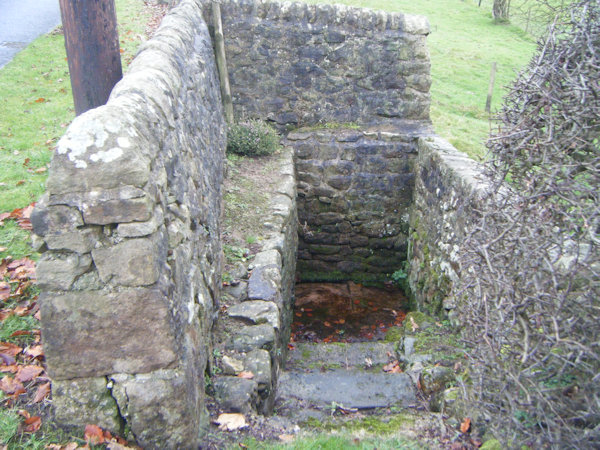
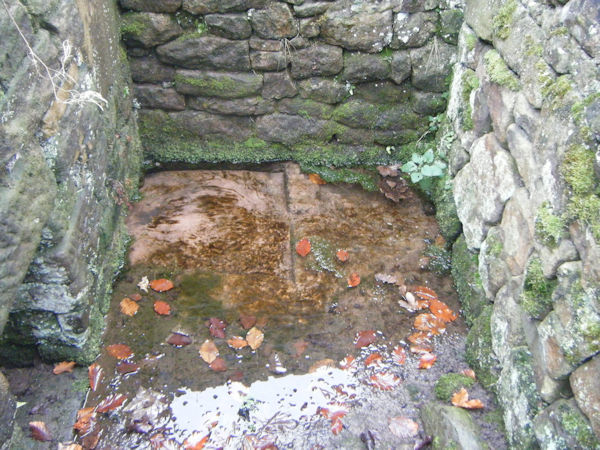
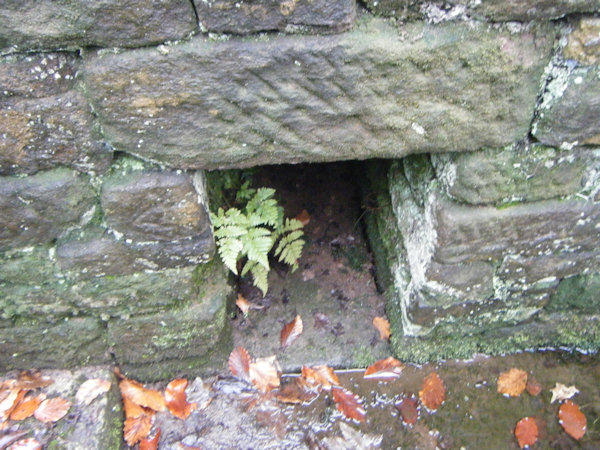
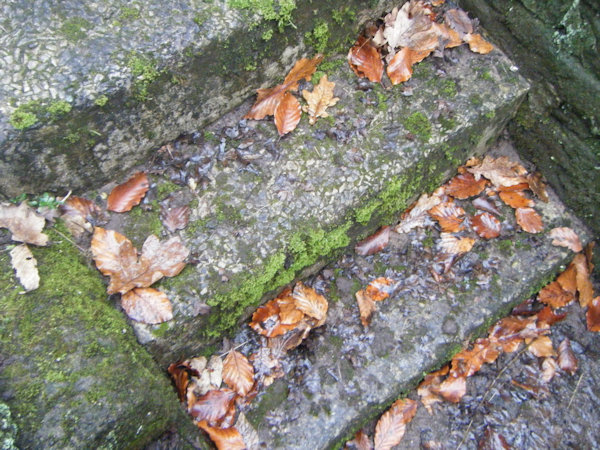
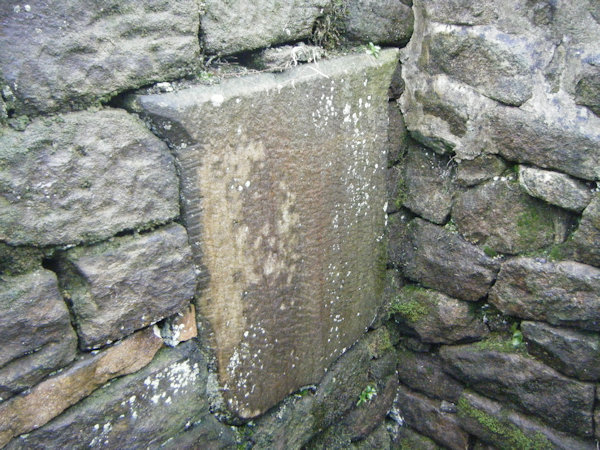
When I visited the site in November 2024, I found that the substantial structure housing the spring was in remarkably good condition. A set of steps, the original versions of some of which had evidently been replaced by concrete, led down to the water, which issued into a very silted-up stone basin, only the top few centimetres of which could be seen. There was an intriguing stone-lined cavity, perhaps half a metre deep, in the eastern face of the structure, which may perhaps once have housed offerings. More interesting than that, however, was a large stone shield, blank, and built into the wall just above it and to the right; if this once bore a coat of arms, then it this had worn off completely by the time of my visit. It is not clear at all how old this entire structure is, but the inclusion of the mysterious alcove and the coat of arms suggests that it is at least several centuries in age.
 |
 |
 |
 |
|
Access: The well is located at the side of a busy road, and caution should definitely be taken when crossing it. It is advisable to walk to the well along the grassy verge that flanks the road. |
Copyright 2025 britishholywells.co.uk