 |
Dedication: St Mary the Virgin Location: Holbrook Common Coordinates: 51.4601N, -2.43722W Grid reference: ST697735 Heritage designation: none |
HOME - ENGLAND - GLOUCESTERSHIRE
|
Dedication: St Mary the Virgin Location: Holbrook Common Coordinates: 51.4601N, -2.43722W Grid reference: ST697735 Heritage designation: none |
Holbrook Common appears to have possessed a holy well since at least the late 12th century, when the name "Holbrook", according to the Historic Environment Record, is first known to have been recorded. The record attests that it was mentioned "in 1189" (although I have been unable to identify where exactly this reference was made), and, as "Holbrook" is derived from the name "Holy Brook",[1] evidently referring to the holy well, it must have existed at this time.
Nevertheless, the earliest direct reference that I have found to the well itself dates from 1779, when it was mentioned in Samuel Rudder's New History of Gloucestershire. Rudder called the hamlet "Holy Brook", instead of "Holbrook", and wrote that it took its name from "a spring dedicated to the holy virgin".[2] Unfortunately, however, Rudder recorded nothing else about the well or its history, although his statement was later repeated by at least one other author.[3] Indeed, the only other direct mention of the site that I have found appears in Cross Country, written by Walter Thornbury in 1861. Thornbury echoed Rudder's claim that the well is dedicated "to the Virgin Mary", but added that it was still "supposed to possess miraculous powers of healing"; he did not specify what ailments in particular the well was being used to heal.[4] What is perhaps particularly interesting is that I have found no sources which mention the holy well by name: it is therefore impossible to know whether it was originally known as "St Mary's Well", "Lady Well", or simply "Holy Well".
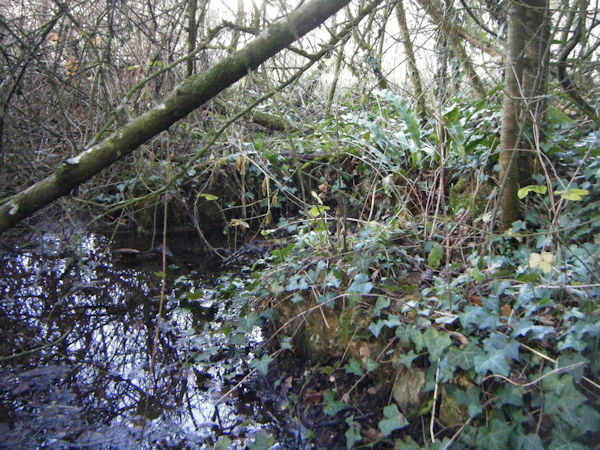
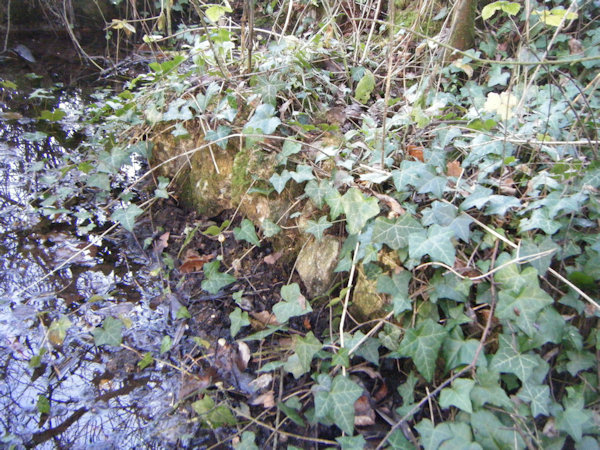
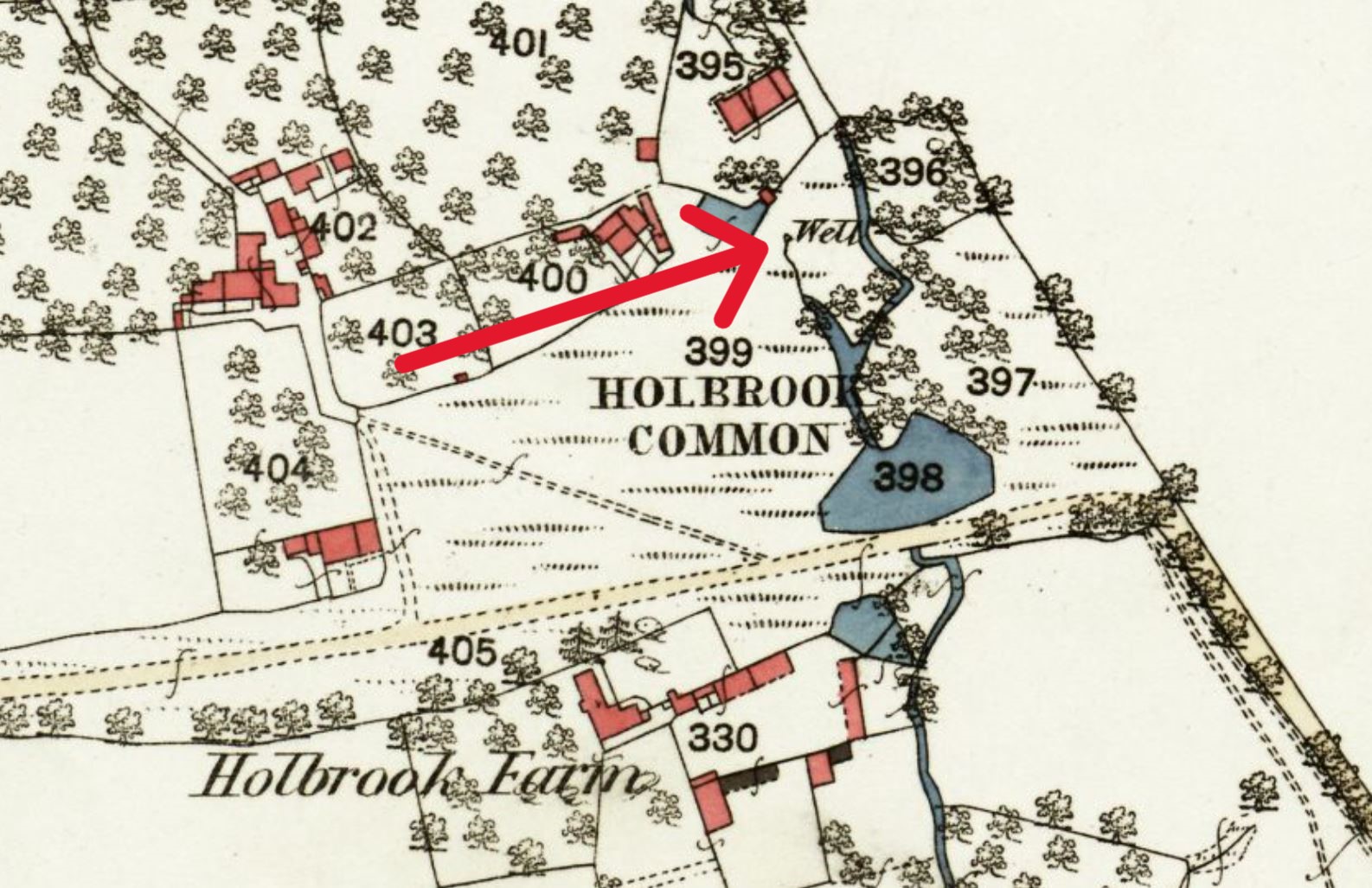
Even Ordnance Survey maps, every published edition of which depicts the holy well, do not give the site a name. They do suggest that the well was in constant use, however, because from 1882 (when the first edition[5] was issued) onwards, the "Well" is shown surrounded by grass, meaning that it would have been easily accessible. Even as late as 1965, access to the spring seems to have been kept clear.[6] However, when I visited the well in December 2025, I found that a dense thicket had been allowed to grow around it, and it was completely obscured from view. Nonetheless, some remnants of a structure could still be seen around the edges of the spring: the water appeared to arise in a shallow, rectangular stone-lined pool (probably measuring around half a metre lengthways), before issuing into a stream, or the "Holy Brook". The stonework did not look particularly old, but had evidently not been maintained for several decades.
I also spoke to one of the inhabitants of Holbrook Cottage, located directly opposite the well, who knew of its existence, but had never seen it herself because of how inaccessible the site has become. However, I was able to speak to her mother Margaret, who had lived opposite the well for her entire life, and informed me that it had originally supplied all of the houses in Holbrook, apart from Holbrook Farm,[7] with water. She remembered having to collect the water from the spring in galvanised steel buckets until about the 1950s, and that it had been surrounded by stone, covered by a lid, and reached via a concrete path that led to the spring. She also said that it had been inhabited by frogs, although, when mains water was installed, she told me that its water had been deemed unfit for consumption and was covered over. Both she and her daughter said that, around thirty years previously, it had been decided to restore the well for "tourists", but problems with health and safety had meant that the plans were abandoned. Somewhat unsurprisingly, they had never met any other visitors to the well.
Most interestingly, however, Margaret informed me that her mother, who had also lived on Holbrook Common all her life, used to say that the spring was a "holy well" and that she had seen people coming to the well to bathe their eyes. As her mother was born in the 1880s, this would fit with Walter Thornbury's mention of the well's "miraculous powers of healing".[4] Margaret herself said that she had never seen the well being used in this way, and was unaware of its dedication to St Mary, meaning that any traditions linked to it must have died out by the mid 1900s.
 |
 |
|
Access: A public footpath runs right beside the well, which, though very overgrown, was just possible to access on my visit in December. |
References and footnotes:
Images:
Old OS maps are reproduced with the permission of the National Library of Scotland
Copyright 2026 britishholywells.co.uk